
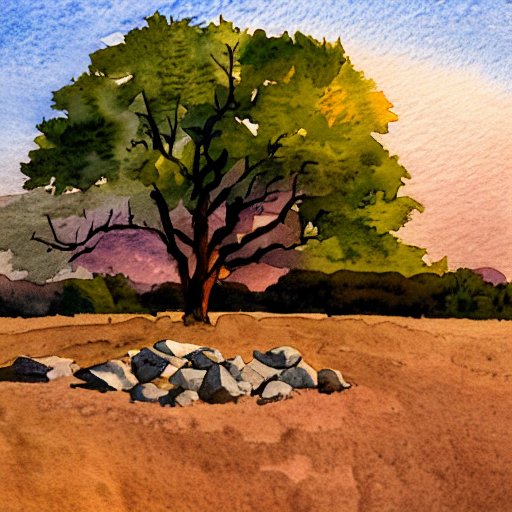
At noon, on the second day of their journey, the old monk, Dominic, and the young novice, Anthony, were sitting together high up on a rocky outcrop. They sat in silence, looking southwards. The flat grassland before them stretched as far as the eye could see and was remarkable in its featureless monotony, a monotony interrupted, here and there, by the odd lone tree, growing far from its neighbour and stunted by the elements. Over and through the whole scene blew the warm summer breeze, bowing the skinny trees and making the tall grass sway and billow. Anthony munched on an apple.
‘The way yon grass moves is, to me, so alike unto waves upon the sea as to make me think I might throw off this habit and plunge myself full into it,’ he said.
Dominic remained silent and looked out into the distance.
‘I know of what I speak,’ continued Anthony, ‘for the monastery wherein I did finish my schooling was nigh unto the sea and how often, I do confess, in those early days of my childhood, did I, not without accomplice, skip away from my masters and my duties to frolic and cavort in the salty waves.’
Dominic lifted his hand at the landscape. ‘“The wind blows where it wishes. You hear the sound of it, but you cannot tell where it comes from nor where it goes.”’
Anthony had finished his apple now, and he lifted the core and hurled it out into the scene. It fell silently into the grass amidst a flock of larks which erupted up, like a splash, and flew away on the wind to the west. Anthony’s eye having watched the birds, he could no longer remember when he looked back again, where the core had fallen, nor when he looked up again could he trace the path of the birds in the sky.
Dominic stood, picked up his staff, slung his bag over his shoulder and turned to walk down and off the promontory. Anthony stood, picked up his bag, and followed.
‘You say, novice, that your schooling was finished, but the learning is not yet done,’ said Dominic without turning around, ‘nor will it ever be, should you confirm your vows at Jvari.’
‘Yes, Brother Dominic,’ said Anthony.
‘And will you confirm your vows, novice?’
‘God willing, I have a mind to, sir.’
‘Ah. A mind,’ said Dominic.
They were walking south-east, travelling from the Gelati monastery of Kutaisi to the Jvari monastery on the Kura River. They needed no map, no guide, for they knew that a south-eastern course would bring them to the Kura River and that the river, in turn, would lead them to Jvari. To travel south-east and to choose the most passable ways before them, these were the simple tenets of their journey. Today, in this particular landscape, they kept to the track of some large animal; the grass on either side, waist-high, brushed softly against their habits as it bowed under the unction of the wind. They walked in silence for some time.
Eventually, they came to a place where the animal track split in two. Dominic stopped.
‘Look there,’ said Dominic, gesturing towards a tree growing where the paths diverged. Anthony regarded the tree, its leaves shimmering and its slender trunk bending. ‘“Here is the tree that brings forth its fruit in season,”’ intoned Dominic from the first Psalm, ‘“whose leaf shall not wither; and here,”’ he continued, reaching down to the grass at his side, ‘“the chaff which the wind drives away.”’ He gathered a fistful of stems and pulled upwards, stripping the seed into his hand. Stretching out his upturned palm, he released the seed to the wind and watched until it had all been blown away. His gaze returned to the tree, and a tear rolled down his cheek. ‘Would, by God’s grace, that our lives were fruitful,’ he said and fell to his knees in prayer. Anthony knelt, too, and bowed his head. They stayed for some time in this attitude: Dominic, eyes closed, his clasped hands tapping gently against his forehead; Anthony feeling the roughness of his hessian habit, pressed by the hard earth against the skin of his knees.
Eventually, Dominic, pulling heavily on his staff, stood up again and set off on the path to their left, chosen perhaps because it rose up a little over the one to their right. Anthony followed.
That night, Dominic and Anthony sat on the bare earth, either side of a small fire. The air was still and warm. The stars twinkled overhead, but the moon gave no light, being fully in its shadowed phase. Anthony commented on this.
‘How peacefully the earth sleeps when the moon cloaks itself thus,’ he said, pointing at the dark disk near the horizon. ‘It is truly a sabbath amongst sabbaths. Yet, when I was in my childish state, I did not think it so, but rather, on such nights as this, the deeper darkness was but a cover for my darker deeds, and I did loose myself from restraint and, not without accomplice, slip out of the window unto the orchard to gorge myself, unseen and without shame, on fruit that was not mine to have; neither by ownership nor by toil. I did steal, Brother Dominic. And so my flesh took the opportunity of goodly rest as opportunity for ill work – and how ill was I on the morrow, wracked with all the cramps that too much unripe fruit will inflict on the gut! How I did writhe upon my bed and groan and inwardly confess my faults and despise my folly. Inwardly I confessed, I say, for my inward pains were enough; I needed no outward application of hurt.’
Dominic regarded Anthony across the fire for a moment. Then, glancing about in the amber light, he gathered a small stone and a tuft of grass. He wrapped the stone tightly in the grass, carefully tucking in the ends so that it wouldn’t unravel, and held it up to Anthony.
‘You know sin can so easily entangle?’ he asked. Anthony nodded, and Dominic tipped the stone in amongst the glowing embers. The dry grass smoked gently and then ignited in a flame that flared up in an instant, only to die away again as quickly. Dominic poked the stone with a stick, and the ashen strands fell off. ‘“Our God is a consuming fire,”’ he said softly, and then he lay down on his side and rested his head on his bag to sleep. Anthony, seeing his master recumbent, quickly tidied around the fire and then, rolling his own bag into a pillow, he too lay down to sleep.
The following day Dominic and Anthony continued their walk south-eastwards. The sun climbed, the heat increased, and the landscape around them became more varied. Not too far ahead, they could see a profusion of rocky outcrops, and behind these, at a great distance, the rising of mountains. Around noon, they climbed up another rock to rest and eat. In one hand, Anthony held a small roll of bread, and in the other, he held the stone from the fire of the night before.
‘Imagine if I were without sense,’ said Anthony. ‘It does seem that there are those so afflicted. Either they seem born without sense, or perchance some mishap may knock them so athwart themselves that the sense seems to flow out of them, like water from an upturned bucket. I had an uncle, Jack. All did say he had been an upright, sensible soul until one Whitsun, a malicious ass, tethered mark you, did up and thwack him with a good kick to the side of his head. He fell down like a dead man, they say, but the breath didn’t leave the body. Time it was when he could stand again and walk, and though he had the pulse, it seemed all his sense was lost; couldn’t feed nor wash nor dress himself, and that near drove his poor wife to acts of mischief. Now imagine him here, holding this stone and this bread. Being so alike in size and shape, I doubt he would have the sense to know which one was meet to eat and which one wasn’t!’ Anthony licked the stone and then looked at it. He then took a bite from the bread and chewed for a while. ‘I am persuaded by Uncle Jack,’ he said, ‘that the mind lives in the skull, behind the eyes, but I have heard those who think this is folly and say it lives in the heart and even others who say it lives lower, in the guts.’ He turned to Dominic. ‘Where do you say that it lives?’ he asked.
‘Here,’ said Dominic, holding his hand to his chest, ‘where the blood pulses. “The life of the flesh is in the blood.’” Anthony stuffed the last of the bread roll into his mouth and then put the stone into his tunic’s pocket, under the scapular.
Over the following three days, they continued their journey south-eastwards. They filled their water skins to bursting in the crystal-clear streams that flowed from the higher ground and stopped to pick berries from bushes laden with ripe fruit. All around them, summer presented itself with such confidence that it was difficult to imagine a different reality. Days were warm, and nights were cool. The evening of the third day, Dominic and Anthony were on yet another promontory, reclining by their campfire. In the embers were the bones of a rabbit they had just finished eating, one that had been snared by Anthony that morning and gutted and skinned with his knife.
‘By my reckoning, we’re but half a day’s journey from the Kura and a further day to Jvari.’ said Anthony.
‘Agreed,’ said Dominic. ‘I would say our journey has been a blessed one. “The lines have fallen out in pleasant places.”’ He flicked a bone into the fire. ‘You buried the guts and the pelt?’
‘Yes,’ replied Anthony.
Dominic nodded.
Evening rolled into night, and a crescent moon rose into a clear sky.
‘Some say the stars make music,’ said Anthony. ‘What a sound that would be! Perhaps that’s why the birds sing; they’ve flown so high they’ve heard it for themselves and bring it back to earth to bless us and bathe us in heavenly songs. I used to have a sweet voice when I was in my infancy, and I could make the highest notes as good as any. Now I can make the lowest notes as good as any, and I prefer it. Prior at Gelati says my intoning at compline is meet for the close of day, being low and sonorous.’
The old monk turned from reclining to lying and gazed up at the stars. ‘“The starry host are lead forth by number; each one is called by name,”’ he said, to which Anthony replied,
‘Amen.’
‘The vows, boy,’ said Dominic.
‘Yes?’ said Anthony.
‘Will you take them at Jvari?’
‘I am inclined to,’ said Anthony, ‘but fear prevents me.’
‘Fear of what?’ asked Dominic.
‘I am shy to say it, but I am fearful of the learning,’ said Anthony. ‘I am strong in body and can lift and carry and toil all the day long, but I was never strong in my learning. I fear that in surrendering my life to learning, I will fail, and if the doctrines of God become too heavy, then what shall sustain me?”
‘My boy, you talk of life and learning as two separate paths. You separate the body and the mind. Did not our one God make both, each to serve and minister to the other? Unite the two, for each one is made alive in the other. Think on it again and be at peace, young novice; you need surrender nothing; you need only to live in the way of life.’
‘I shall think on it, Brother Dominic.’
They were silent again for a while, and in the darkness, they heard the soft contented chirp of the crickets and the rustling of the breeze playing in the long, dry grass. Soon there was added to this world the sound of Brother Dominic’s deep snoring.
‘Nature is calling,’ said Anthony to himself, ‘and I shall make water.’ He stood and, taking care in the near-dark, made his way down and off the promontory to a small tree not far away. Having finished at the tree, he was walking back when his eyes suddenly locked with two bright stars ahead of him, two bright stars that blinked and moved slowly but steadily closer. Anthony squinted and held his breath. There, in the space between himself and the promontory, he saw the darkness congeal into a darker form, a darker shape that moved, crouching and contorting, in his direction. In a moment, Anthony was back at the tree. In the next instant of a moment, he heaved himself up into the branches as the thing leapt. Scrabbling up far as he could, he turned to see the animal below. The form paced, and the two stars looked up at him. Anthony gripped onto the branches and pulled his feet higher up under himself. ‘Enough!’ he shouted, ‘Enough!’ but the creature coiled and erupted up the tree in a roaring blur. Anthony roared back and struck out with his foot but made no contact. The animal fell back and began pacing around the tree, a low growl idling in its throat. Anthony suddenly remembered the stone under his scapula. He grabbed it and held it high. The thing leapt. Anthony cried out and hurled the stone, and then there was a shout. Anthony looked up. Dominic was rushing through the grass to the tree, waving the staff above his head, shouting at the thing.
‘No, Dominic!’ cried Anthony, but it was too late. The creature had turned and was upon the old monk, and Anthony saw him go down under it. Dropping down out of the tree, Antony ran to the knot of noise and violence. He picked up the white staff and struck at the animal, struck at it again and again. He struck at it until, at last, the thing rolled and uncoiled and stole off to melt back into the night. Anthony was down, kneeling by the old monk’s side.
‘Brother Dominic!’ he cried, but there was no answer, only a raspy gargling breathing, and Anthony felt a warm wetness about a ragged gash in the old man’s throat. The old man lifted wet fingers and pressed them against Anthony’s forehead, and the fitful breathing stopped.
Hours later, the rising sun cast long shadows westwards from a mound of stones, newly piled at the base of the promontory. Further off to the east, it warmed Anthony as he walked on, staff in hand and two bags slung over his shoulder. By mid-morning, he had skirted around lake Nadarbazevis, and by mid-day, he had dropped down into the valley of the Kura River to follow its mighty flow south-east. He walked without stopping, his regular, steady pace eating up the miles until, by late afternoon, he saw Jvari monastery perched high on a hill, nestling between trees and caught in the light of the setting sun. Anthony was soon upon the path that wended its way up the wooded hillside to the monastery. Here the trees on either side were tall and straight and met together high above to form a natural vault, which flexed and rustled in the wind.
The monk of Jvari, who heard the banging at the door, and who rushed out to see who it was, found only Anthony, clinging to the upright staff, his forehead marked with blood. His arrival in such a state, and his account of Brother Dominic, disquieted the whole monastery. Younger monks tried to hide their curiosity, older monks their grief. The prior quickly called together a conclave of senior brothers to discuss the case. Anthony was given food and a cell in which to rest. The following day, he was summoned to the prior’s study; it was late afternoon.
‘From the account you have given us,’ said the prior, ‘we have agreed that the animal that killed Brother Dominic was, most likely, a panther from the mountains.’ He leaned forward and placed his elbows on the desk. ‘In a few days, you will lead a small expedition back to his grave so that we might pray and raise a cross. Brother Dominic was well known to this monastery, and his death, and the manner of his death, have broken the rhythm of our devotion. A good reminder that God’s calling upon a soul may be at any hour, in any place.’
‘Indeed, it seems so,’ said Anthony.
‘And you have told us of God’s calling upon your own life, to proceed with the vows of monasticism,’
‘Yes,’ replied Anthony.
‘To know only poverty, chastity and obedience?’
‘Unto my last breath,’ replied Anthony.
‘You were with Brother Dominic at his last,’ said the prior. ‘Did you see the light of eternity reflected in his eyes?’
‘Sir, it was very dark,’ said Anthony, ‘and I was in some distress, but as I knelt by him, he touched my forehead, and in my mind, it seemed I heard him whisper something to me.’
‘Yes?’ said the prior.
‘And as I piled up the stones to bury him, I heard his whisper echo in their knocking together. I heard it, too, in the waves as I walked by Nadarbazevis. I heard it in the great rushing might of the Kura River and again in the woods on the path from the valley. I heard it as I raised his staff to strike upon the door of the monastery, and I hear him whisper it to me even now, here.’
‘And what does he whisper?’ asked the prior.
‘Vivat!’ replied Anthony. ‘Live life!’
The prior rested back in his chair and regarded the youth standing before him. ‘And do you consider this God’s calling,’ asked the prior, ‘coming to you, as it does, through tragedy?’
‘Yes, I do,’ replied Anthony, ‘for was not Job, in his tragedy, given answer out of the storm? And in the storm at Horeb, was not Elijah spoken to in a whisper? And at both times, having heard it, did not their hesitancy melt and mould itself into the gracious hand of God, as has happened in me?’
‘Quite true,’ replied the prior, ‘and well said. So be it. Tonsure and the cross tomorrow. And might your way be worthy of the life that was given for it. Now leave, and ready yourself through fasting and prayer. Brother Paul will assist you.’ Anthony nodded, turned and walked from the room. On his descent of the stairs, he was suddenly halted by a view of the outside world afforded by a small, square window. Through it, Anthony could see the valley below, where the Kura and the Aragvi rivers met, their broiling confluence silent at this distance. On the steep valley sides, he saw the forests rising to the mountain peaks and marching off, along the ridges, to the west. And far in the west, far out on the horizon, shone the amber radiance of the setting sun. And as he gazed into that western twilight, he saw, in his mind’s eye, dark shadows lengthening over a mound of stones piled under a lone tree, a lone tree which lived and grew and bowed in the restless wind.
 West Folio